Kabila Stripped of Immunity, Faces Treason Charges Amid YouTube Takedown
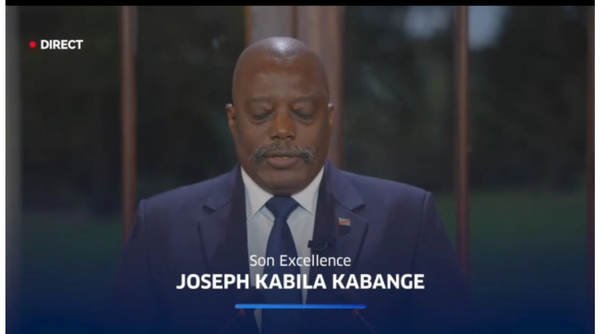
KINSHASA, May 24 (Cameroon Concord / RFI) – A political firestorm is sweeping the Democratic Republic of Congo following the release of a rare public address by former president Joseph Kabila, which was streamed on the YouTube channel “Reconstruire RDC” and watched by over 50,000 viewers before the platform was abruptly suspended and all content deleted.
Kabila’s speech — his first major appearance since 2023 — was widely seen as a coded political comeback message, loaded with veiled criticism of President Félix Tshisekedi, who was pointedly never named in the address. Analysts say Kabila’s military-style presentation and combative tone signalled a strategic repositioning rather than mere reflection.
“His shaved head and precise moustache aren’t just aesthetics — they’re symbols of readiness,” said a military analyst in Goma. “This wasn’t a speech. It was a warning.”
Kabila denounced tribalism, militias, and political impunity — themes that observers say aim to recast him as a national unifier amid ongoing eastern conflict.
CHANNEL TAKEDOWN AND POLITICAL CRACKDOWN
Soon after the broadcast, the Reconstruire RDC channel was taken offline without formal explanation. Activists suspect government pressure may have led to the removal, calling it an act of political censorship.
The shutdown coincides with a dramatic escalation in legal action against Kabila. On May 23, the Congolese Senate voted 88–5 to strip him of his immunity, opening the way for prosecution over alleged ties to the Rwanda-backed M23 rebel group, which controls parts of eastern DRC.
“No Congolese is above the law,” declared Senator Jean Tshisekedi, praising the vote as “historic.”
Kabila, who has been out of the country since 2023, is accused of conspiring with M23 to destabilize the state. A testimony — allegedly obtained under duress — claims Kabila told M23 commanders to overthrow Tshisekedi by force. The Congolese army's public prosecutor deemed the allegations "credible and constant."
The former leader now faces potential military court charges for treason, war crimes, and insurrection.
POLITICAL REACTIONS AND DIVISION
Critics of the Senate’s decision, including the PPRD, Kabila’s party, called it a witch hunt. PPRD spokesperson Ferdinand Kambere rejected the Senate’s authority, insisting Kabila, as a former head of state, is subject to a special legal regime.
In a defiant statement on social media, Kabila condemned the decision as “a desperate political manoeuvre made in panic” and warned of institutional overreach.
“He woke up from a six-year coma and thinks he's still monarch,” mocked one Congolese commentator online.
Others, like opposition figure Jean Marc Kabund, warned against criminalizing political dissent:
“No one remains powerful forever. The struggle for democracy must never be criminalized.”
UNCERTAIN FUTURE
With Kabila’s media channel silenced, his immunity removed, and criminal charges looming, observers believe the former president is at a critical crossroads — facing either legal downfall or a daring return to the national stage.
Was Kabila’s speech a warning or a political resurrection? Will the charges unite or divide the Congolese public? Can a former head of state still play the role of national redeemer, or is this the final chapter of the Kabila legacy?
- Details
- News Team
- Hits: 2218
