In a controversial visit to Haiti on Saturday, Kenyan President William Ruto asserted that the security situation in the Caribbean nation has "significantly improved" due to the efforts of Kenyan police forces deployed earlier this year to combat escalating gang violence.
However, Ruto’s claims were swiftly contradicted by United Nations experts and local Haitians, who report that violence continues to worsen as gangs strengthen their grip on the country.
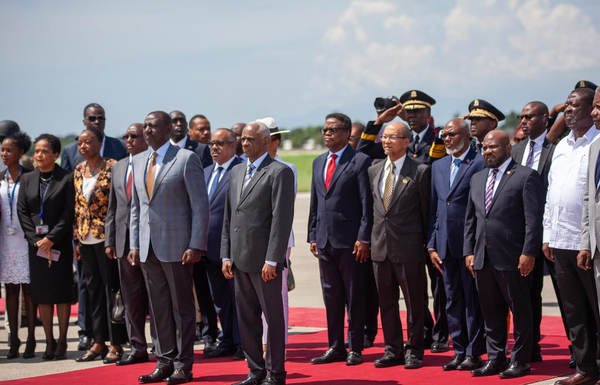
Arriving at Port-au-Prince’s Toussaint Louverture Airport, Ruto walked past a guard of armed officers before heading to a Kenyan base at the airport. There, he met with the police contingent charged with tackling Haiti’s notorious gangs, alongside Haitian and Canadian officials. Ruto praised the work of the 400 Kenyan officers who have been in Haiti since June, asserting that their presence has bolstered security infrastructure and enabled displaced Haitians to return to their homes.
However, these optimistic remarks were met with skepticism. Many Haitians living in gang-controlled areas, as well as international observers, contest Ruto’s narrative. They argue that violence has remained unabated, with some even stating that the situation has deteriorated since the arrival of the Kenyan forces.
Earlier this week, a U.N. security expert issued a stark warning about the escalating violence in Haiti, highlighting that gangs are expanding their control, particularly in the capital, Port-au-Prince, where they now control about 80% of the city. This power vacuum has been exacerbated by the political instability that has plagued Haiti since the 2021 assassination of President Jovenel Moïse.
Kenya’s police deployment is part of a larger international effort, spearheaded by the United Nations, to restore some semblance of order in Haiti. Jamaica has also joined the mission, recently sending a small contingent of police and soldiers. Yet, despite these contributions, the United States and other nations have expressed concerns that the number of foreign forces remains insufficient to effectively combat the well-armed and deeply entrenched gangs that continue to terrorize the nation.
Ruto acknowledged these challenges, stating that his visit aimed to assess the progress made by the Kenyan police and identify the resources needed to further strengthen their capabilities. His next stop is New York, where he is expected to meet with U.N. leaders to discuss additional support for the Kenyan and Jamaican forces already on the ground.
While Kenya has taken a leading role in the U.N.’s international intervention in Haiti, it remains unclear whether these efforts will be enough to address the dire situation in a country where governance has effectively collapsed, and criminal networks wield unchecked power.
For the people of Haiti, Ruto’s reassurances have done little to quell fears. As one local resident lamented, “Violence is just as bad, if not worse, than when the police first arrived. We don't feel any safer."
The situation in Haiti remains precarious, and the international community will need to mobilize significantly more resources and personnel if they hope to restore stability to the beleaguered nation.