Tchiroma outlines 6 priority pillars to “refound Cameroon.”
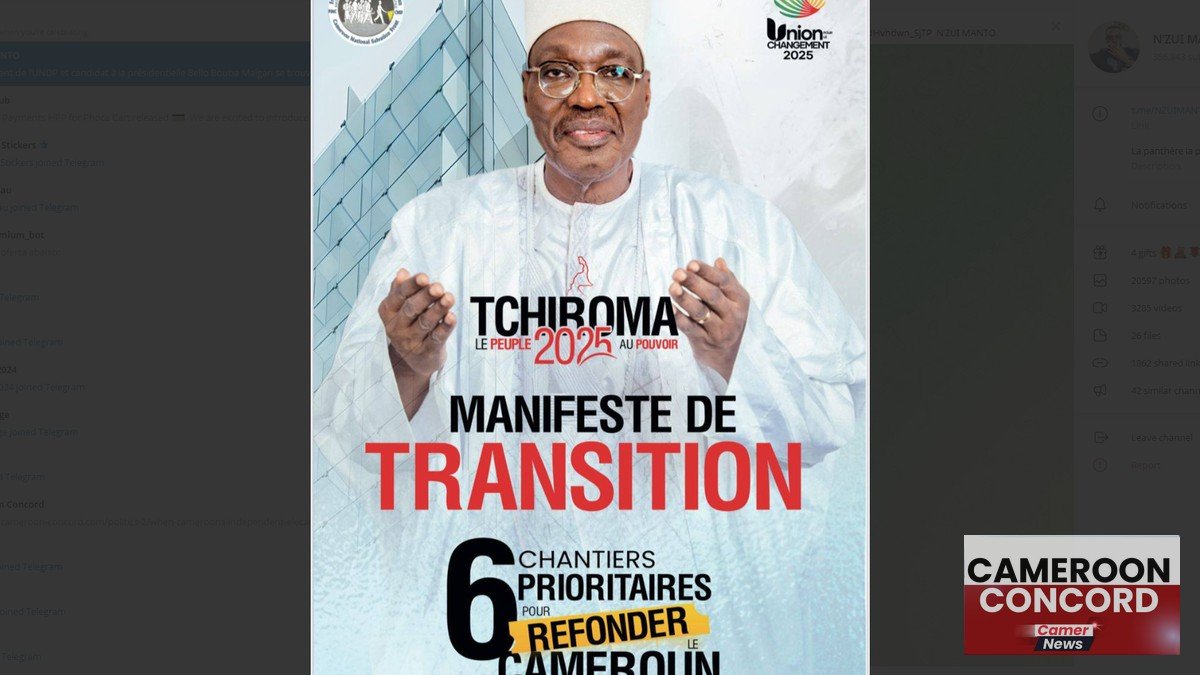
Issa Tchiroma, candidate in Cameroon’s October 12 presidential election, has presented his political blueprint, the “Transition Manifesto”, promising deep reforms in governance, economy, and national reconciliation.
The October 12 presidential race has taken a new turn with the official unveiling of Issa Tchiroma Bakary’s “Transition Manifesto.” The document, presented under the banner Union for Change 2025, lays out six major priority areas which, according to the long-time politician, are indispensable for a peaceful transition of power and the reconstruction of a fractured nation.
At the heart of the program lies a commitment to peace and reconciliation. Tchiroma promises to restore security across the national territory through inclusive dialogue and reform of the armed forces. He insists on opening “a grand dialogue without taboos” and establishing a Truth, Justice and Reconciliation Commission aimed at healing wounds, acknowledging past abuses, and assigning responsibility.
A second priority concerns the audit of the state. The manifesto calls for a full, independent review of Cameroon’s finances, debt, natural resources, and public assets. Tchiroma ties this to his vow to fight corruption and introduce strict governance mechanisms — a stark contrast to the opacity and systemic embezzlement that have defined the Biya era.
Economically, the plan emphasizes structural reforms to secure sovereignty and modernize key sectors. Tchiroma promises major investments in agriculture, energy, and local industries, while creating special economic zones across each region to stimulate growth. Digital transformation also features prominently, with pledges to expand Cameroon’s tech ecosystem, support startups, and rework tax policies to favor private investment and “Made in Cameroon” production.
Institutional reform is another pillar. The candidate envisions a constitutional reform that revisits the form of the state, with attention to regional realities. He proposes a new electoral code that guarantees free and fair polls, alongside stronger, independent watchdogs such as a reformed Supreme Court, Constitutional Council, and Audit Court. Recognition of dual nationality also appears in the document, addressing a long-criticized gap in Cameroonian law.
On the diplomatic front, Tchiroma commits to pan-African solidarity and a multipolar foreign policy, seeking stronger ties with ECOWAS, CEEAC, the African Union, BRICS, Gulf countries, Europe, and the Americas. He insists Cameroon should become a regional hub for peace, finance, and commerce, while mobilizing the diaspora as a critical economic and diplomatic force.
Finally, the social dimension of the manifesto focuses on free education up to secondary school, an overhaul of curricula, universal health coverage, and targeted programs for youth and women. Access to credit, vocational training, and entrepreneurship support are listed as tools for reducing unemployment and inequality.
While Issa Tchiroma presents this roadmap as a credible alternative to the ruling CPDM, skeptics argue that his long service within Biya’s system may compromise his reformist credentials. Still, the manifesto’s clarity and ambition mark it as one of the most detailed proposals released so far in the campaign.
As Cameroon edges closer to October 12, the key question remains: will Tchiroma’s promises resonate with a weary electorate, or will they be dismissed as yet another campaign manifesto destined to fade after the ballots are cast?
- Details
- News Team
- Hits: 2369
