Politics
Cameroon and Nigeria remain two neighbouring countries that are conscious of the important links they share, with leaders of both nations showing the example. Since the establishment of diplomatic ties between Cameroon and Nigeria in 1960, the stakes and circumstances that have guided the evolution of relations have been numerous. Besides the land and maritime boundaries that they have in common, the socio-cultural and historical links binding both countries have been such that leaders of the two nations are bound to come together as often as possible.
Already, with the 16 February 1963 Friendship and Cooperation Accord as well as the Protocol Accord of 6 February 1963 on the Freedom of Movement for Persons and Goods, Cameroon and Nigeria set the pace at the dawn of independence for long-lasting diplomatic, cultural, economic and political cooperation crystallized in the 15 agreements governing the bilateral relations. At the summit, which is between Heads of State of both countries, the number of times they have met was generally motivated either by the need to strengthen cooperation or dictated by their belonging to common international organisations.
Thus, in recent years, Presidents Paul Biya and Olusegun Obasanjo met in Yaounde and Abuja for over five times and on several other occasions on foreign land to iron out differences and reinforce cooperation ties between the two nations. For instance, President Obasanjo came to Cameroon in 1999 and 2004 while Mr Biya met him in Nigeria in 1991 and 2003. Even when Mr Obasanjo left power, he still joined President Biya in Yaounde in 2010 for festivities marking 50 years of Independence and Reunification of Cameroon alongside another former Nigerian leader, Yakubu Gowon.
The resurgence of conflict over the Bakassi Peninsular led to President Biya and Obasanjo meeting in France, Geneva and New York on numerous occasions between 2002 and 2006 when they signed the Greentree Agreement of 12 June 2006 to seal the procedure provoked by the 2 October 2002 Verdict of the International Court of Justice reaffirming Cameroonian sovereignty over the disputed peninsula.
Such a bona-fide solution to cross-border conflict accepted by both leaders and subsequent Nigerian Presidents like Alhadji Umaru Musa Yar’adua (2007-2009) and Goodluck Ebele Jonathan 2010-2014), serve as model of cooperation for others to emulate. Even before his investiture as Head of State of the Federal Republic of Nigeria, President Musa Yar’adua made his maiden official visit to Cameroon and his successor, Goodluck Jonathan followed his footsteps in 2010.
President Paul Biya did not only take part in their swearing-in ceremonies, but was equally present on 1 October 2010 in Abuja during festivities to mark 50 years of the independence of Nigeria. With the growing security threats that both countries continue to face, the need for both leaders to increase regular contacts became even more urgent. As such, President Goodluck Jonathan was again in Cameroon from 24-25 June 2014 to take part in discussions by Heads of State and Government on Maritime Security in the Gulf of Guinea.
The outcome of the different meetings has been evident. In 2008, the Grand Mixed Commission between Cameroon and Nigeria resumed discussions with its fourth session in Yaounde from 9-11 October 2008 and the fifth in Abuja from 23-24 November 2010, while the sixth session took place from 9-11April 2014 in Yaounde and the seventh is programmed for June 2016 in Abuja. All the high-level talks between leaders of Nigeria and Cameroon have yielded palpable fruits in areas of security, consular and immigration challenges, economic, commercial, scientific, judicial and socio-cultural domains.
Given the ever challenging threats posed by the Boko Haram extremists who have inflicted torture and misery on innocent citizens in northeast Nigeria, with spill over effects in Cameroon, Chad and Niger. The presence of the newly elected Nigerian leader, Muhammadu Buhari in Cameroon today the 29 of July 2015 will certainly be another milestone in relations between both countries and of course, a sign of more happy days to come for their people.
- Details
- Ngwa Bertrand
- Hits: 1548
Plans for nationwide CPDM rallies in favor of early elections were scuttled when First Lady Jeanne-Irène Biya died suddenly in the early hours of July 29 from an undisclosed illness.
"Madam is Dead" - Cameroon Tribune, July 30, 1992.
Only a week earlier, a beaming and and apparently healthy First Lady had been on TV receiving American musician Stevie Wonder at Unity Palace. Her sudden death, just hours after President Biya left for a meeting in Dakar, Senegal, led to widespread rumors that she had been assassinated:
Although some die-hard opponents of the Biya regime seemed to derive pleasure from the First Lady’s untimely death, the virulently anti-Biya private media demonstrated a rarely seen “softer side” as it declared a truce and appealed to the public and opposition leaders to honor Jeanne-Irène Biya. For example, the “extremist” Challenge Hebdo appealed to Cameroonians to break away from this infernal logic (of intolerance) and go back to the tradition of paying our respects to the dead. Dead, Madam Biya deserves our respect. Our political differences with Mr. Biya should give way to the ethical obligation of respecting the dead.
“Let us forgive JIB and pray for a kinder and gentler Cameroonian nation,” chimed in Cameroon Today. Jeune Afrique Economie, which only a few weeks earlier had lambasted the First Lady for her alleged role in the collapse of the SCB paid her a glowing tribute, particularly for her charitable activities. The “hard core” opposition parties also followed suit with messages of condolence to the Head of State. The SDF went a step further and temporarily suspended all public rallies and meetings in honor of the fallen First Lady.
During a high mass at the Yaounde Cathedral attended by thousands of national and foreign dignitaries including Zairean President Mobutu Sese Seko, Bishop Jean Baptiste Ama declared: “Now that Jeanne Irene is dead, there is absolutely nothing she can do about her fate. Only our prayers can make God have pity on her.” And on September 1, 1992, the First Lady who, according to Bishop Owono Mimboe, had “undergone moral and physical torture just like Christ,” was buried in Paul Biya’s village of Mvomeka’a as a nation which seemed to have lost its soul in the acrimony and violence of the last two years remorsefully looked on.
On September 3, a condolence register was opened at Unity Palace and by the time it closed on September 7, thousands of Cameroonians from all walks of life and all political persuasions had stopped by to pay their last respects to the departed “madam” as she was fondly called.
Regime strategists, however, refused to be distracted by the nationwide outpouring of grief or by the conciliatory attitude of the regime’s political enemies. Thus, as soon as Jeanne-Irène Biya’s funeral was out of the way, the campaign to drum up support for early presidential elections resumed in earnest in mid September when traditional rulers from the West province were dragged to Unity Palace to make another public appeal for early elections. CPDM sections all over the country immediately joined the fray with rallies begging President Biya to run for another mandate.
On August 25, 1992 President Biya announced during a nationwide address that he would seek another term as President and that early elections would take place on October 11, 1992.
And the rest is history...
- Details
- Ngwa Bertrand
- Hits: 3923

Boko Haram Takfiri militants are still holding on to some territories in Nigeria's troubled northeast, local governors say. State governors from the troubled northeastern region told a monthly national economic council meeting in the capital Abuja on Thursday that the militant group still controls five municipalities within the northeastern Borno and Yobe states. "On Boko Haram issues, governors of Yobe and Borno raised the alarm of five local government areas of the two states still being in possession of the insurgents," an official three-page document made available to reporters after the meeting said.
The governors called for an "increase in military deployment and provision of sophisticated military equipment in those areas," the document added. “Insurgents are still hiding in the Sambisa forest," it went on to say. It is widely believed that over 200 schoolgirls kidnapped from their school in Chibok, Borno State, by militants in April last year are being held in the sprawling forest there.
Nigerian armed forces have managed to free hundreds of hostages from Boko Haram captivity in their offensives in Sambisa, from where the militant group has planned and executed many of its terrorist operations. Adamawa, Borno, and Yobe states in the troubled northeast have suffered the brunt of the Boko Haram militancy. The Takfiri group has also targeted mosques, villages and markets in neighboring Borno State in a fresh wave of attacks that have killed hundreds of people in recent months.
Nigerian President Muhammadu Buhari has vowed to tackle Boko Haram militancy which is currently plaguing the West African nation. On Wednesday, President Buhari lashed out at the United States for refusing to provide his soldiers with weapons in their fight against Boko Haram. Buhari said Washington “aided and abetted” the militants in his country by refusing to arm Nigerian forces.
- Details
- Ngwa Bertrand
- Hits: 684

Violent explosions were heard in Maroua late this evening in a busy drinking spot. 19 persons have been reportedly killed and over 60 injured. The injured have been rushed to the Maroua Regional Hospital.
- Details
- Ngwa Bertrand
- Hits: 2615

Suspected Boko Haram Takfiri militants have killed at least 21 people during an attack on a village in northeast of Nigeria, local residents say. A resident said Saturday that the militants stormed the village of Maikadiri in Borno State at about 9:00 a.m. local time (0800 GMT Friday) and opened fire on people. "They laid siege in daylight because there are no soldiers or police nearby," said another resident, putting the death toll at 21. The attackers "killed, destroyed and then fled," he added.
A police officer, speaking on condition of anonymity, also confirmed the attack. According to local residents, many people fled the village while many houses and shops were set ablaze. On July 22, at least eight people were gunned down by the Takfiri militants during a raid on the village of Pompomari in the troubled Borno State.
- Details
- Ngwa Bertrand
- Hits: 1936

As the Cameroon Army relentlessly takes the war to Boko Haram, the deadly suicide bombing that took place recently in Maroua is a reminder that defeating and weaning the sect would take more than just a military solution. We have heard of attacks in Fotokol and other peripheral towns but hitting the capital of the Far North Region takes the threat to a whole new level and calls for more serious implication than we have seen so far.
In other parts of the world, when such an attack takes place, it is the commander in chief who leads the charge in issuing an appropriate response. For the commendable leadership that he has shown, issuing a communiqué was just not the appropriate response from the President of the Republic in the face of such a calamity. Since he announced the war against Boko Haram, the President has hardly communicated to Cameroonians in a direct manner on where we are with the fight against Boko Haram.
President Biya is not known to communicate much, but fighting Boko Haram is something that must be done on multiple fronts. Yes the Cameroonian people have voiced strong disdain against the sect and its activities, we have seen donations across other regions of the country, we have seen artists engaged and we have even seen a controversial march organized by journalists to mobilize support for the troops and condemn the sect . With an attack like the one that took place in Maroua, President Biya ought to come out swinging, how about a televised address to the nation? Is a communiqué the best way the leader could send a message to the sect?
Following the communiqué was a visit to Maroua by the Minister of Defence representing the Head of State.While the minister may be in charge of the troops doing the heavy lifting in fighting Boko Haram, he is certainly not the most senior member of government.In the absence of the Commander in Chief going to the field, is it not appropriate to send a more senior cabinet member? A few weeks back, there was a strong debate on why the President has not visited the Grand North region, or even stopped at the military hospital or the military headquarters to pay homage to the troops.Such aloofness does a disservice to the valiant efforts of our military.
Not long ago, the personal security Aide of the President of the National Assembly was arrested supposedly for colluding with Boko Haram to kidnap him . As disturbing as this allegation was, Cameroonians seem to have moved on as usual without asking the hard questions. The Aide of Hon Cavaye was arrested in Yaounde, Cavaye is the third personality in the Republic. He is on record for declaring in a speech at the National Assembly that Boko Haram was amongst us without indicating who there were , or where there were coming from or what was their motivation. Less we forget , the sect has its roots and origins in Nigeria. The Hon President of the National Assembly should put Cameroonians on guard by telling them who the Boko Haram people he was talking about are.
The Grand North regions have some of the most disturbing statistics in Cameroon when it comes to development. From underscholarization to unemployment, health care and basic infrastructure. While the development plan outlined by the President to transform the region is very welcome, the reality must sink in that the people in the region will remain vulnerable. The price for years of neglect, misplaced priorities and collaborators who value self enrichment to serving the common good when appointed by the Head of State is the vulnerability that we have in the region now.
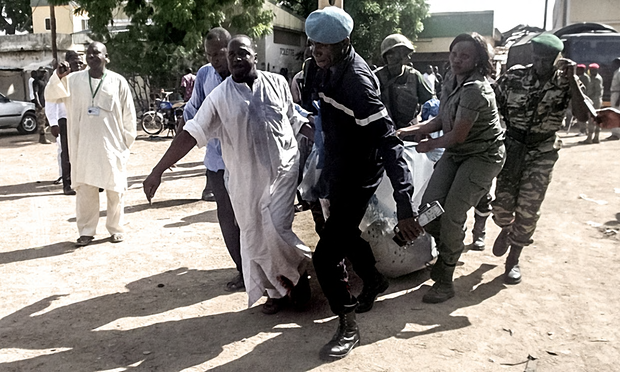
Security forces transport the remains of some of the eleven victims of a double blast in the northern Cameroonian city of Maroua. Certainly other regions of Cameroon have the same problem, porous borders, bad roads and more. For the remainder of his mandate, the President needs to revisit his development policies and whoever succeeds must take a very hard look at development priorities that not only move Cameroon forward but help keep the country secure.
As the Maroua attack rings the alarm bells, the call should not be for people to panic , but to remain vigilant. Vigilant in knowing that you are your neighbors keeping. Vigilance in alerting the forces of law and order on any suspicious movements or actions. As mentioned earlier the military has been be doing a terrific job. Hopefully the President keeps to his words to ensure that the sums donated by Cameroonians to support the military go to serve the needs of those at the battle front. There need all the motivation, there need all the support.
It is a united front that will frustrate efforts of Boko Haram to spread terror in Cameroon. A front where there are no political calculations, where everybody accepts that no matter what, Cameroon must remain peaceful and united. It was Maroua, tomorrow it could be some other town or even some other region and we must remain united and in strong solidarity with people affected by this devilish attacks.
- Details
- Ngwa Bertrand
- Hits: 1575
Subcategories
Biya Article Count: 73
# Paul Biya and his regime
Explore the political landscape of Cameroon under the rule of Paul Biya, the longest-serving president in Africa who has been in power since 1982. Our Paul Biya and his regime section examines the policies, actions, and controversies of his government, as well as the opposition movements, civil society groups, and international actors that challenge or support his leadership. You'll also find profiles, interviews, and opinions on the key figures and events that shape the political dynamics of Cameroon.
Southern Cameroons Article Count: 549
.# Southern Cameroons, Ambazonia
Learn more about the history, culture, and politics of Ambazonia, the Anglophone regions of Cameroon that have been seeking self-determination and independence from the Francophone-dominated central government. Our Southern Cameroons section covers the ongoing conflict, the humanitarian crisis, the human rights violations, and the peace efforts in the region. You'll also find stories that highlight the rich and diverse heritage, traditions, and aspirations of the Southern Cameroonian people.
Editorial Article Count: 885
# Opinion
Get insights and perspectives on the issues that matter to Cameroon and the world with our opinion section. We feature opinions from our editors, columnists, and guest writers, who share their views and analysis on various topics, such as politics, economy, culture, and society. Our opinion section also welcomes contributions from our readers, who can submit their own opinions and comments. Join the conversation and express your opinions with our opinion section.
