Politics

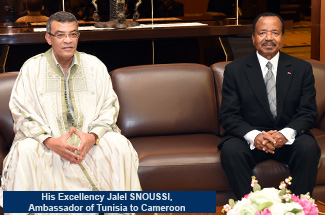
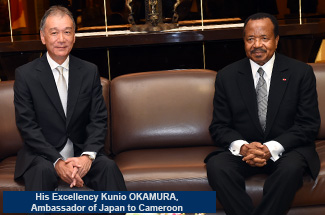
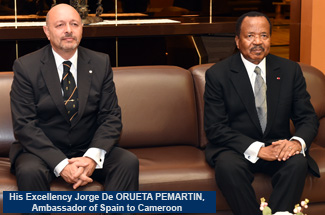
New Ambassadors from Algeria, Tunisia, Japan and Spain presented their letters of accreditation on Wednesday 11 November 2015 to the Head of State His Excellency Paul BIYA, during four solemn diplomatic ceremonies at Unity Palace.
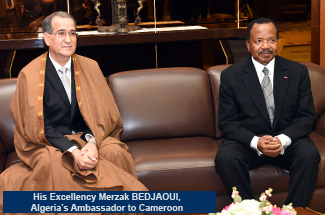 His Excellency Merzak BEDJAOUI, Algeria’s new Ambassador to Cameroon arrived Unity Palace shortly before 11 am, and was led by the Chief of State Protocol to review troops of the Presidential Guard who were on hand for the occasion. The military honours included the singing of the Cameroon National Anthem with the Cameroon flag in position. The diplomat was then led up to the third floor of the main building and introduced to the President of the Republic. He then handed over his letters of credence to President Paul BIYA. He also met with the close collaborators of the Head of State including the Minister of External Relations, Lejeune MBELLA MBELLA; the Secretary General of the Presidency of the Republic, Ferdinand NGOH NGOH; the Director of the Civil Cabinet, Martin BELINGA EBOUTOU; the Commander of the President’s Special Commmand, General Emmanuel AMOUGOU and the Commander of the Presidential Guard, Lieutenant Colonel Raymond Charles BEKO’O ABONDO.
 After a brief discussion with President Paul BIYA, the Algeria Ambassador once more had military honours in the courtyard of Unity Palace, this time with the execution of the Algerian anthem.
It was this same ritual that was undertaken later by the Ambassador of Tunisia to Cameroon, H. E. Jalel SNOUSSI; the Ambassador of Japan to Cameroon, H.E. Kunio OKAMURA; and the Ambassador of Spain to Cameroon, H.E. Jorge DE ORUETA PEMARTIN.
The elaborate diplomatic ceremonies confer full powers on the new Ambassadors to carry out their missions in Cameroon. The ceremonies are also a testimony of the very friendly cooperation ties between Cameroon and Algeria, Tunisia, Japan and Spain.
|
|
|
|
|
|
- Details
- Ngwa Bertrand
- Hits: 2365

Recent resignations and movements to other parties by politicians confirm a trend that has become recurrent since the advent of multi-party politics in the 1990s. It has become normal in Cameroon to hear of top political party officials and members resigning to join other parties. A recent case was in the Mfoundi II Section of the Cameroon People’s Democratic Movement (CPDM) following the arrival of over 80 former members of the Cameroon Democratic Union, CDU, of Dr. Adamou Ndam Njoya.
The militants were welcomed by members of the CPDM Mfoundi II Section in pomp and fanfare on Thursday, October 29, 2015. The new arrivals recalled that they decamped from the CPDM to the CDU several years ago and were now coming back. They said they were encouraged by the inclusive approach to development by CPDM Mfoundi II Section President and Yaounde II Mayor, Luc Assamba. While accepting CPDM party uniforms and gadgets, the carpet-crossers pledged commitment to the ideals of the CPDM party.
Four days earlier on October 25, 2015 in Bamenda, North West Region, SDF’s key activist, Dr Fomambu Lawrence announced that he was returning to the National Union for Democracy and Progress, NUDP, from which he decamped in 2003 to join the Alliance of Progressive Forces, AFP, of Bernard Muna; before ending up in the SDF. In the same vein, Maidadi Saïdou who left the SDF for AFP is now in the NUDP. Tayong Jacob and Mudoh Walters also crossed from AFP to NUDP.
Another resignation that made headlines recently was that of former Member of Parliament of the Social Democratic Front, SDF, party, Dr. Aka Amuam, who joined the CPDM party. Reasons given by political carpet-crossers do not seem to convince a critic like Dr. Eric Mathias Owona Nguini. He says the phenomenon in Cameroon is motivated by opportunism and the hope for political gains. “It shows that our political scene is not strongly structured around one of the fundamental principles which are the ideology, moral and technical orientation that political parties must uphold in running public affairs and ensuring political governance.
It also indicates that there exists a certain level of precariousness which obliges people to change parties,” he argued. However, the risks are obvious because resigning militants might be treated with suspicion in their new political parties, Dr. Owona Nguini warns. “So, they have to show proof of their loyalty and fidelity,” he advised, adding that this exigency could be very difficult because their new comrades will also have in their heads that “he who once betrayed will always betray.”
- Details
- Ngwa Bertrand
- Hits: 1756

Recent resignations and movements to other parties by politicians confirm a trend that has become recurrent since the advent of multi-party politics in the 1990s. It has become normal in Cameroon to hear of top political party officials and members resigning to join other parties. A recent case was in the Mfoundi II Section of the Cameroon People’s Democratic Movement (CPDM) following the arrival of over 80 former members of the Cameroon Democratic Union, CDU, of Dr. Adamou Ndam Njoya.
The militants were welcomed by members of the CPDM Mfoundi II Section in pomp and fanfare on Thursday, October 29, 2015. The new arrivals recalled that they decamped from the CPDM to the CDU several years ago and were now coming back. They said they were encouraged by the inclusive approach to development by CPDM Mfoundi II Section President and Yaounde II Mayor, Luc Assamba. While accepting CPDM party uniforms and gadgets, the carpet-crossers pledged commitment to the ideals of the CPDM party.
Four days earlier on October 25, 2015 in Bamenda, North West Region, SDF’s key activist, Dr Fomambu Lawrence announced that he was returning to the National Union for Democracy and Progress, NUDP, from which he decamped in 2003 to join the Alliance of Progressive Forces, AFP, of Bernard Muna; before ending up in the SDF. In the same vein, Maidadi Saïdou who left the SDF for AFP is now in the NUDP. Tayong Jacob and Mudoh Walters also crossed from AFP to NUDP.
Another resignation that made headlines recently was that of former Member of Parliament of the Social Democratic Front, SDF, party, Dr. Aka Amuam, who joined the CPDM party. Reasons given by political carpet-crossers do not seem to convince a critic like Dr. Eric Mathias Owona Nguini. He says the phenomenon in Cameroon is motivated by opportunism and the hope for political gains. “It shows that our political scene is not strongly structured around one of the fundamental principles which are the ideology, moral and technical orientation that political parties must uphold in running public affairs and ensuring political governance.
It also indicates that there exists a certain level of precariousness which obliges people to change parties,” he argued. However, the risks are obvious because resigning militants might be treated with suspicion in their new political parties, Dr. Owona Nguini warns. “So, they have to show proof of their loyalty and fidelity,” he advised, adding that this exigency could be very difficult because their new comrades will also have in their heads that “he who once betrayed will always betray.”
- Details
- Ngwa Bertrand
- Hits: 1140

Recent resignations and movements to other parties by politicians confirm a trend that has become recurrent since the advent of multi-party politics in the 1990s. It has become normal in Cameroon to hear of top political party officials and members resigning to join other parties. A recent case was in the Mfoundi II Section of the Cameroon People’s Democratic Movement (CPDM) following the arrival of over 80 former members of the Cameroon Democratic Union, CDU, of Dr. Adamou Ndam Njoya.
The militants were welcomed by members of the CPDM Mfoundi II Section in pomp and fanfare on Thursday, October 29, 2015. The new arrivals recalled that they decamped from the CPDM to the CDU several years ago and were now coming back. They said they were encouraged by the inclusive approach to development by CPDM Mfoundi II Section President and Yaounde II Mayor, Luc Assamba. While accepting CPDM party uniforms and gadgets, the carpet-crossers pledged commitment to the ideals of the CPDM party.
Four days earlier on October 25, 2015 in Bamenda, North West Region, SDF’s key activist, Dr Fomambu Lawrence announced that he was returning to the National Union for Democracy and Progress, NUDP, from which he decamped in 2003 to join the Alliance of Progressive Forces, AFP, of Bernard Muna; before ending up in the SDF. In the same vein, Maidadi Saïdou who left the SDF for AFP is now in the NUDP. Tayong Jacob and Mudoh Walters also crossed from AFP to NUDP.
Another resignation that made headlines recently was that of former Member of Parliament of the Social Democratic Front, SDF, party, Dr. Aka Amuam, who joined the CPDM party. Reasons given by political carpet-crossers do not seem to convince a critic like Dr. Eric Mathias Owona Nguini. He says the phenomenon in Cameroon is motivated by opportunism and the hope for political gains. “It shows that our political scene is not strongly structured around one of the fundamental principles which are the ideology, moral and technical orientation that political parties must uphold in running public affairs and ensuring political governance.
It also indicates that there exists a certain level of precariousness which obliges people to change parties,” he argued. However, the risks are obvious because resigning militants might be treated with suspicion in their new political parties, Dr. Owona Nguini warns. “So, they have to show proof of their loyalty and fidelity,” he advised, adding that this exigency could be very difficult because their new comrades will also have in their heads that “he who once betrayed will always betray.”
- Details
- Ngwa Bertrand
- Hits: 1517

Last November 4, 2015, the group of 2,500 soldiers and officers from the Chadian army that came to provide Cameroon’s forces its support (since January 2015) in the fight against Nigerian Islamist group Boko Haram in the far North of the country, returned to N’Djamena, Chad’s capital city.
According to Chad’s authorities, the retreat is subsequent to the arrival of the multinational Force which now leads operations relating to the fight. This force comprises member-states of the Commission of the Lake Chad basin. It counts 8,700 men from Cameroon, Nigeria, Benin and Chad, and has its headquarters situated in N’Djamena.
Financed by the International community, this army’s main objective is to eradicate Boko Haram who has already killed thousands in Nigeria, Cameroon, Niger and Chad.
- Details
- Ngwa Bertrand
- Hits: 1999

Republican U.S. presidential contenders attacked Donald Trump's views on Syria and Russian President Vladimir Putin on Tuesday as simplistic and unrealistic, and rival Jeb Bush said the real estate mogul did not grasp "how the real world works." Trump, who has led opinion polls in the 2016 Republican race for months, praised Putin's efforts to fight Islamic State militants and said he would back the Russian leader "100 percent" in that effort. “If Putin wants to go and knock the hell out of ISIS, I am all for it, 100 percent, and I can’t understand how anybody would be against it,” Trump said during the fourth Republican presidential debate. "We have to get smart. We can’t continue to be the policemen of the world," Trump said, adding that the possible bombing of a Russian plane by militants meant "he cannot be in love with these people. He's going in and we can go in."
But Bush, a former Florida governor, leaped to question Trump's understanding of the conflict, saying the billionaire was "wrong on this." "We’re not going to be the world’s policemen, but we sure as heck better be the world’s leader," Bush said, saying Trump's views of Putin and his policies in Syria were "like a board game. That’s like playing Monopoly or something. That’s not how the real world works." Other Republican contenders had few kind things to say about Putin. "Mr. Trump ought to know that we should not speak to people from a position of weakness," said former business executive Carly Fiorina. "I've never met Vladimir Putin, but I know enough about him to know that he's a gangster," U.S. Senator Marco Rubio of Florida said.
Trump also came under fire for his immigration plan, which would build a wall on the border with Mexico and round up and deport undocumented immigrants. Ohio Governor John Kasich and Bush both criticized Trump's plan, which many Republicans fear will alienate Hispanic voters who are vital to winning the November 2016 election. "That's the problem with this. We need to win the presidency, and the way you win the presidency is to have practical plans," Bush said, adding Democratic front-runner Hillary Clinton's staff was "high-fiving" over the proposal. A Clinton campaign spokesman, Brian Fallon, tweeted during the debate that "we actually are doing high-fives right now." Trump and Kasich also clashed after Kasich told the flamboyant billionaire that "False little things, sir, they really don't work when it comes to the truth." Trump replied that he had built a company worth billions of dollars. “I don’t have to hear from this man, believe me," he said of Kasich, drawing boos from the crowd.
The debate comes at a critical time in the race for the Republican nomination, with retired neurosurgeon Ben Carson and Trump fighting to hold their spot atop polls and Rubio trying to build on the momentum of his last strong debate performance. Carson has faced a rough week of scrutiny about whether he embellished key aspects of his biography, while Rubio, 44, is under pressure to show he can fight off recent criticism of his inexperience as he tries to unseat fellow Floridian Bush as a favorite of the party's mainstream. Carson lashed out at his critics and said he did not like being "lied about." Carson has faced a series of reports in the past week casting doubt on his stories about his violent outbursts as a youth and a scholarship he said he was offered to the U.S. Military Academy at West Point. "I have no problem with being vetted," Carson said. "What I do have a problem with is being lied about and having that put out there as true." Carson, questioned why Clinton had not been subjected to a similar level of media scrutiny. "We have to start treating people the same and finding out what they really think," he said. "People who know me know I’m an honest person."
In an earlier debate on Tuesday involving four lower-polling Republican candidates, several accused the Federal Reserve of keeping U.S. interest rates low for political reasons and one called for replacing Fed chair Janet Yellen. "The Fed should be audited, and the Fed should stop playing politics with our money supply," New Jersey Governor Chris Christie said. Louisiana Governor Bobby Jindal tried to distinguish himself by repeatedly attacking Christie and former Arkansas Governor Mike Huckabee for failing to cut government spending during their tenures as governors. Christie declined to take the bait, turning the debate back again and again to the need for Republicans to rally around a nominee who can defeat Clinton, who leads in polls.
- Details
- Ngwa Bertrand
- Hits: 2183
Subcategories
Biya Article Count: 73
# Paul Biya and his regime
Explore the political landscape of Cameroon under the rule of Paul Biya, the longest-serving president in Africa who has been in power since 1982. Our Paul Biya and his regime section examines the policies, actions, and controversies of his government, as well as the opposition movements, civil society groups, and international actors that challenge or support his leadership. You'll also find profiles, interviews, and opinions on the key figures and events that shape the political dynamics of Cameroon.
Southern Cameroons Article Count: 549
.# Southern Cameroons, Ambazonia
Learn more about the history, culture, and politics of Ambazonia, the Anglophone regions of Cameroon that have been seeking self-determination and independence from the Francophone-dominated central government. Our Southern Cameroons section covers the ongoing conflict, the humanitarian crisis, the human rights violations, and the peace efforts in the region. You'll also find stories that highlight the rich and diverse heritage, traditions, and aspirations of the Southern Cameroonian people.
Editorial Article Count: 885
# Opinion
Get insights and perspectives on the issues that matter to Cameroon and the world with our opinion section. We feature opinions from our editors, columnists, and guest writers, who share their views and analysis on various topics, such as politics, economy, culture, and society. Our opinion section also welcomes contributions from our readers, who can submit their own opinions and comments. Join the conversation and express your opinions with our opinion section.
